

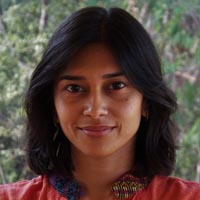
Meghna Krishnadas
Scientist-D
 -24006379
 meghna[at]ccmb[dot]res[dot]in
Research Interests
The diversity of life has long fascinated humans. The processes that allow species to coexist and thus maintain diversity in ecological communities form the research focus of our lab. We study why some species are common but most species rare. What mechanisms help rare species persist and keep communities diverse? Further, in a world overwhelmingly shaped by humans today, we want to know how human influence affects the mechanisms that maintain diversity and restructure ecological communities. To this end, we combine ecological theory, experiments and observational field research with advanced statistical models. In particular, we use functional traits – heritable characteristics that mediate species’ response to different conditions – to understand patterns and processes that shape biodiversity in different ecosystems. We use plant communities as model systems, but the concepts apply across many ecological communities. Ultimately, our lab is driven by theory and curiosity.
Research in the lab can be broadly grouped into the following themes: 1) Climate change impacts on forest regeneration, 2) Ecological dynamics in human-modified forests, and 3) Functional traits and species response to gradients. See here for more details of our research.
Selected Publications
Krishnadas M, Kumar N, and Comita LS. Edge effects reduce ?-diversity but not ?-diversity during community assembly in a human-modified tropical forest. Ecological Applications (ACCEPTED)
Krishnadas M, Bagchi R, Sridhara S, Comita LS. 2018. Weaker plant-enemy interactions decrease tree seedling diversity with edge-effects in a fragmented tropical forest. Nature Communications 9: 4523. DOI: https://doi.org/10.1038/s41467-018-06997-2
Krishnadas M et al. 2018. Environment and land-use history together predict species distributions and functional diversity of tree communities in a temperate forest landscape. Ecological Applications 28: 2142-2152. https://doi.org/10.1002/eap.1802
Krishnadas M, Agarwala M, Sridhara S and Eastwood E. 2018. Parks protect forest cover in a tropical biodiversity hotspot, but high human population densities can limit success. Biological Conservation 223: 147-155. https://doi.org/10.1016/j.biocon.2018.04.034
Krishnadas M & Comita L.S. 2017. Influence of soil pathogens on early regeneration success of tropical trees varies between forest edge and interior. Oecologia 186: 259-268. https://doi.org/10.1007/s00442-017-4006-1
Education & Experience
P.G.:
Wildlife Biology and Conservation ; Tata Institute of Fundamental Research ; National Centre for Biological Sciences, Bangalore, India
Post-doctoral Research:
Campus Fellow ; National Centre for Biological Sciences, Bangalore, India ;
Research Affiliate ; Yale University, New Haven, USA ;
Doctoral studies ; Yale University, New Haven, USA ;
No publications found for this person.