

CSIR - Centre for Cellular & Molecular Biology
The Innovation Engine of India
Elementor Test
- Home
- /
- Elementor Test
Add Your Heading Text Here
Lorem ipsum dolor sit amet, consectetur adipiscing elit. Ut elit tellus, luctus nec ullamcorper mattis, pulvinar dapibus leo.

Lorem ipsum dolor sit amet, consectetur adipiscing elit. Ut elit tellus, luctus nec ullamcorper mattis, pulvinar dapibus leo.
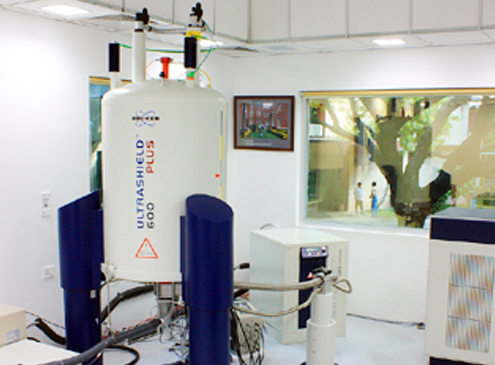
Biomolecular NMR Structural Biology Facility
CCMB houses a state-of-the-art 600 MHz NMR Spectrometer equipped with a cryogenically cooled probe.
Key strengths
- Only method for acquiring structure determination in aqueous solutions under near-physiological conditions.
- Analysing the dynamics of biological macromolecules at timescales ranging from ps-ns, μs-ms, and ms-s.
- Assessing the transitional states during protein folding.
- Advantageous for detecting transient and weak interactions of biomolecules.
- Access to protein-ligand interactions occurring with different affinities , such as, strong (nM), intermediate (μM), and weak (supra – μM) at the atomic level.
Detailed description
A 600 MHz narrow-bore NMR facility was set up in 2009 to study the biomolecular structure and function under physiological conditions in solution. The facility consists of a four channel NMR spectrometer equipped with a cryogenically cooled probe. The enhanced sensitivity of the cryoprobe allows de novo 3D structure determination of relatively large proteins (MW > 25 kDa) and nucleic acids as well as their ligand-bound complexes at the physiological condition. In addition, the spectrometer is routinely used to study dynamic events occurring in the biomolecules at a variety of timescales.
This facility is useful for performing structural studies of dynamic biomolecules that are difficult to crystallize (e.g., multi-domain proteins and majorly disordered proteins). The spectrometer is routinely used to derive biologically relevant conformational flexibility of proteins and nucleic acids in situ. Some of the important findings derived from the data generated by the facility are: (1) The solution structure of RDE-4 (C. elegans) elucidated structural modifications in both dsRBDs that were responsible for selecting the trigger dsRNA (2) Understanding the RNAi initiation in plants through the solution structure complemented with the structure-based activity assays of DRB4 (A. thaliana) (3) The solution structure of Crc (~32 kDa and presumably the largest solution structure derived by NMR from India) revealed its non-canonical RNA binding surface responsible for regulating the carbon catabolite repression process (4) Understanding the process of enantioselection to elucidate the mechanism of chiral proofreading during protein translation.
Over the years, NMR (Structural Biology) has become an integral part of CCMB’s research activities and has immensely contributed to numerous projects including studies and design of thermostable lipases, studies on antimicrobial peptides, study of the interaction of intracellular loops of GPCRs with membranes, and structure-function relationships of key proteins in P. falciparum, among others. The data generated by the NMR facility has been used in research articles published from CCMB in several internationally acclaimed scientific journals such as Proc. Natl. Acad. Sci. USA (2010), J. Mol. Biol. (2011), eLife (2013), Biochem. J. (2014), PLOS Biol. (2016), Nucl. Acids Res. (2017), and J. Magn. Res. Open (2022).
For Use
Head-BDG
Phone: +91-40-27195541
Email: bdg@ccmb.res.in
Accessibility
Academic and Industries